Smart Office Design Strategies for West Palm Beach
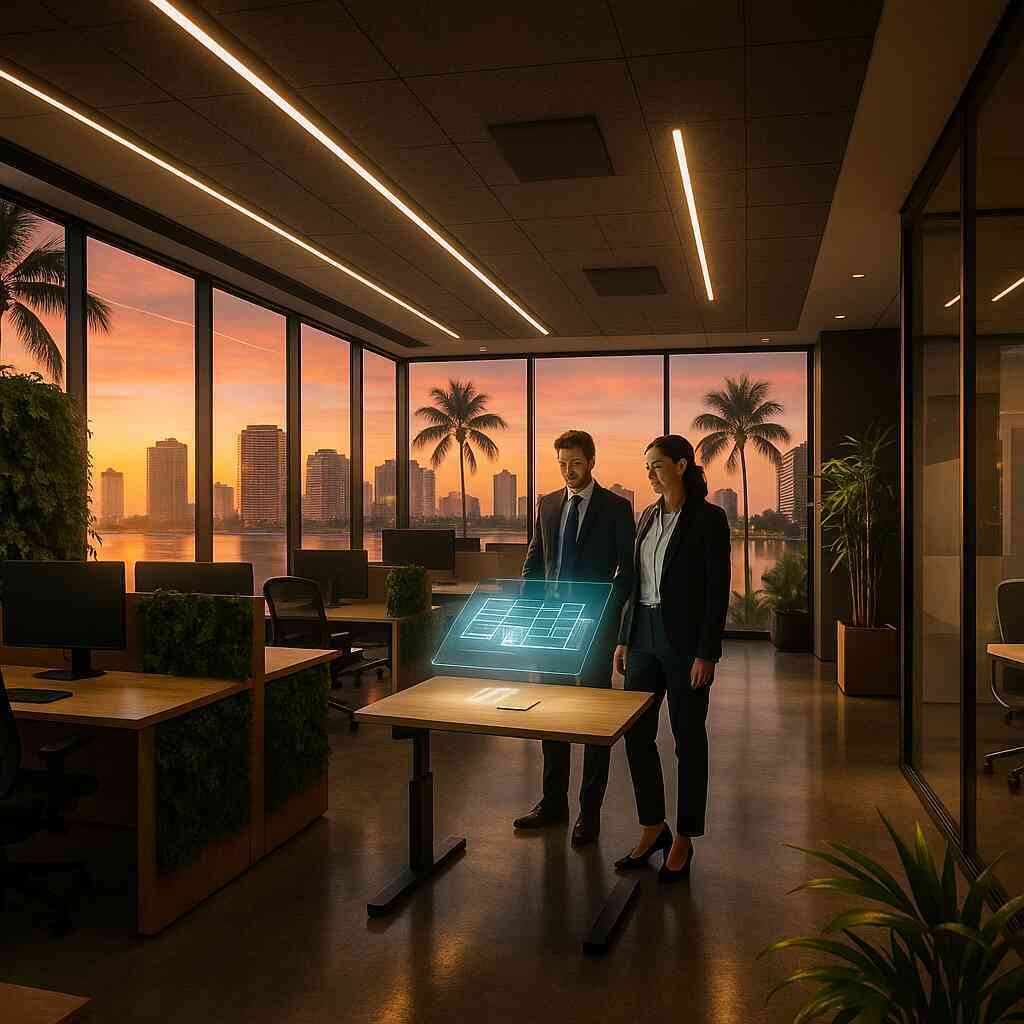
Rethinking the Office in 2026
The modern workplace in West Palm Beach is no longer a fixed address. It is a flexible asset that must perform for on-site staff, remote collaborators, and the ever-evolving business climate. This guide highlights the core principles smart contractors use to deliver high-performance office renovations that meet those demands.
1. Hybrid Work Sets the Brief
Hybrid schedules create peaks of activity that an old-fashioned floor plan cannot absorb. Successful renovations now begin with two questions:
- How many people will be in the space on an average day?
- How quickly do those numbers change week to week?
Answering both drives three design moves:
- Modular boundaries – Movable partitions and demountable walls let teams carve out huddle rooms today and reopen them as event space tomorrow.
- Technology first – Fiber runs, wireless access points, and power cores are routed before drywall closes, preventing costly retrofits.
- Data feedback loops – Low-profile occupancy sensors quietly track which zones see real use. Facilities managers can then right-size cleaning, HVAC loads, and even leasing decisions with hard numbers.
2. Adaptive Reuse Over Tear-Down
Palm Beach County’s supply of vintage office shells is large, and knocking them down rarely satisfies sustainability targets. Instead, contractors perform deep forensics—scanning slab loads, electrical capacity, and life-safety gaps—then layer modern systems onto the proven structure. The benefits are tangible:
- Speed – Reusing existing cores and facades cuts weeks off permitting and construction.
- Cost control – Salvaged elements reduce material spend while preserving local character.
- Carbon savings – Embodied energy in steel and concrete stays in place, supporting ESG goals.
Adaptive reuse does require experience. Uneven floor heights, obsolete fire separations, or stray asbestos demand careful sequencing. A seasoned project team vets every condition before design proceeds so field crews are not surprised mid-build.
3. Wellness Moves From Perk to Baseline
By 2026 most lease negotiations cite employee well-being alongside rent and term length. Tenants want proof that a proposed space can reduce absenteeism and turnover. Renovation strategies that meet that test include:
- Biophilic layers – Living walls, daylight corridors, and natural textures support mental restoration. Even a modest fern installation under skylights can reduce stress indicators.
- Smart HVAC zoning – Demand-controlled ventilation ramps airflow up or down based on actual CO₂ levels, not a fixed timer.
- Low-VOC materials – Paints, sealants, and flooring with verified emissions data keep indoor air crisp from day one.
- Acoustic planning – Sound-absorbing baffles above focus desks and white-noise emitters in open areas keep speech privacy intact without creating a tomb-like hush.
4. The Smart Design Toolkit
Below are the hardware and software layers appearing most often in forward-looking West Palm Beach projects:
| Tool | Purpose |
|---|---|
| Height-adjustable desks | Promotes movement and individual ergonomics |
| Mobile storage cubes | Allows teams to clear floor space in minutes |
| Cable-ready floor tiles | Places power and data exactly where furniture lands |
| LED fixtures with PoE drivers | Reduce energy draw and enable app-based dimming |
| Zoneable VRF HVAC | Fine-tunes temperature by department rather than by floor |
| Digital room booking panels | Prevents conference-room squatting and wasted square footage |
All components share two qualities: they install fast and they can be re-programmed without opening walls.
5. Implementation Checklist
A concise sequence helps owners keep momentum and budget visibility:
- Discovery workshop – Leadership, facilities, and IT map ideal activity zones.
- Space-use audit – Sensors or badge data verify current occupancy patterns.
- Infrastructure assessment – Engineers confirm slab strength, riser capacity, and code gaps.
- Concept design – Floor plans pair each activity with the right flexibility level.
- Cost model and phasing – Value tiers (must-have vs. nice-to-have) keep priorities straight.
- Permitting and procurement – Long-lead smart devices are ordered early to dodge delays.
- Construction with live monitoring – Project dashboards track milestones and change orders in real time.
- Post-occupancy tuning – Sensor data guides tweaks to lighting presets and HVAC setpoints during the first 90 days.
6. Pitfalls to Avoid
- Ignoring cyber security – Every new sensor is a potential entry point. Coordinate with IT on encryption and network segmentation.
- Over-theming – A jungle in the lobby is fun until maintenance crews cannot keep plants alive. Balance aesthetics with upkeep.
- Under-communicating changes – Staff need clear move-in guides and training on desk-booking apps, or the best features will sit idle.
7. Final Takeaway
Smart office design is not a finish schedule; it is an operating system for space. When hybrid work, adaptive reuse, and employee wellness align under a data-rich approach, businesses gain a workplace that advances culture and bottom-line performance at the same time. West Palm Beach’s climate, building stock, and talent pool make it a prime arena for these strategies. A renovation that embraces flexibility today will still feel fresh when work patterns shift again tomorrow.
Smart Office Design Keys with West Palm Beach Renovations


Comments
Post a Comment