How RENOVA Defines and Builds Net Zero Offices in South Florida
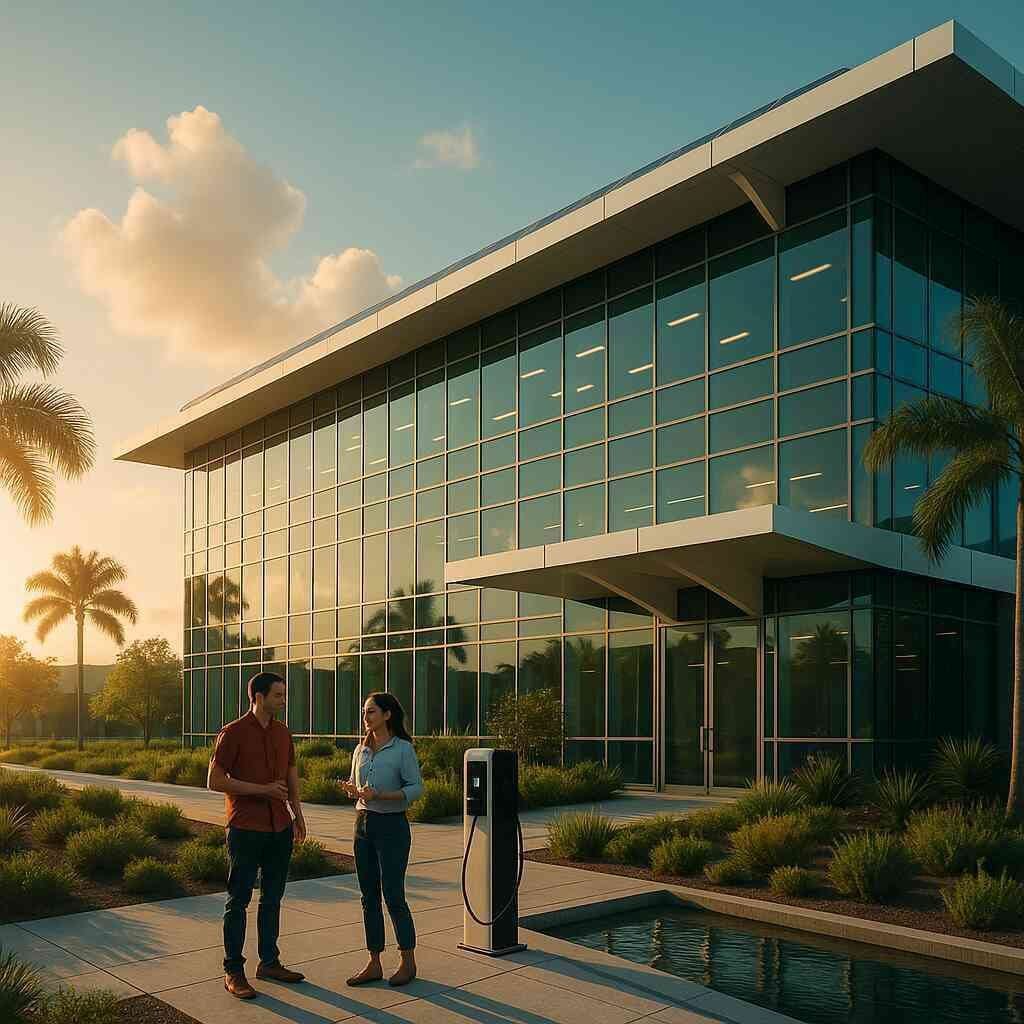
How RENOVA Defines and Builds Net Zero Offices in South Florida
Net zero offices are no longer a distant concept for Palm Beach County businesses — they are a practical, financially sound strategy that RENOVA helps clients design and build today. This overview breaks down what net zero actually means in a commercial construction context, why South Florida companies are pursuing it in 2026, and how RENOVA's integrated approach makes high-performance workplaces achievable.
What Net Zero Really Means for Commercial Offices
A net zero office is one that produces as much clean energy as it consumes over the course of a year. This goes beyond basic energy efficiency. It combines building envelope performance, renewable energy systems, and smart operational controls to reach a balance — or even a surplus.
Some buildings achieve what's called energy positive status, meaning they generate more electricity than they use. Excess power can be fed back to the utility grid through buyback programs, turning a building's energy system into a modest revenue source rather than a pure expense.
Key components that define a true net zero office include:
- High-performance building envelopes — vapor barriers, thermally broken window frames, and reflective roofing that reduce solar heat gain
- Solar power systems — rooftop photovoltaic arrays sized to meet or exceed annual consumption
- Battery storage — on-site storage that manages peak-hour demand and provides resilience during grid outages
- Passive design strategies — building orientation, shading, and daylighting that reduce mechanical load before any equipment runs
- Advanced air sealing and insulation — particularly important in South Florida's humid climate
Why South Florida Businesses Are Prioritizing This Now
Several converging trends are pushing Palm Beach County companies toward carbon-neutral workspace construction in 2026.
Energy costs are rising. Facility managers who once treated utility bills as fixed expenses are now treating them as controllable variables. A well-designed net zero office can significantly reduce or eliminate monthly electricity costs.
Talent expectations have shifted. Professionals relocating from larger metro areas increasingly expect workplaces that reflect environmental values. Employers offering healthy, climate-aligned offices report stronger retention and measurable productivity improvements.
Investors and lenders are watching ESG metrics. Organizations without credible decarbonization plans face growing scrutiny from institutional investors and commercial lenders. Some companies are already encountering higher insurance premiums and lending hurdles as a result.
Municipal incentives support the move. Local governments across South Florida have introduced expedited permitting and tax incentive programs for green commercial buildings. These programs improve project economics and shorten payback timelines.
RENOVA's Approach: From Concept to Completion
RENOVA treats net zero office construction as an integrated process — not a checklist. The methodology begins in pre-construction, where project goals are mapped against Florida building code energy requirements, budget constraints, and realistic schedules.
Scenario Analysis Before Breaking Ground
Before any construction begins, RENOVA's team develops detailed scenario comparisons. These might weigh a LEED Platinum pathway against a full zero energy building standard, analyzing lifecycle costs, maintenance requirements, and long-term operating savings. Decision makers can evaluate real numbers rather than assumptions, which builds confidence and aligns board-level expectations.
Adaptive Reuse as a Sustainability Strategy
Not every net zero project starts from scratch. Renovating an existing building preserves its embodied carbon — the energy already invested in producing and assembling the structure. RENOVA uses lidar scanning and nondestructive testing to assess existing shells, then models retrofit packages that can meet zero energy standards without requiring full demolition.
Adaptive reuse also moves faster through the entitlement process. Existing zoning, parking, and utility connections reduce approval timelines. Tenants experience less disruption, and owners avoid landfill disposal costs associated with full teardowns.
Envelope Engineering for Florida's Climate
South Florida's heat and humidity require specialized solutions. Generic insulation and standard windows are not sufficient. RENOVA specifies assemblies designed specifically for subtropical conditions — materials that manage moisture, reject heat, and maintain indoor air quality without overtaxing mechanical systems. Getting the envelope right reduces the size and cost of HVAC equipment and dramatically improves long-term performance.
The Business Case in Plain Terms
Net zero offices deliver value across multiple dimensions:
- Lower operating costs from reduced or eliminated utility bills
- Higher asset value as energy efficiency improves a property's capitalization rate
- Stronger leasing appeal to ESG-conscious tenants
- Reduced regulatory and financial risk as carbon reporting requirements expand
- Potential revenue from solar buyback programs
For Palm Beach County businesses evaluating their next facility decision, the question in 2026 is less about whether net zero is worth pursuing and more about how to implement it effectively. RENOVA's construction management methodology offers a structured path from early planning through final commissioning, grounded in local climate knowledge and practical building science.
What Does RENOVA Define as Net Zero Offices Near You


Comments
Post a Comment